
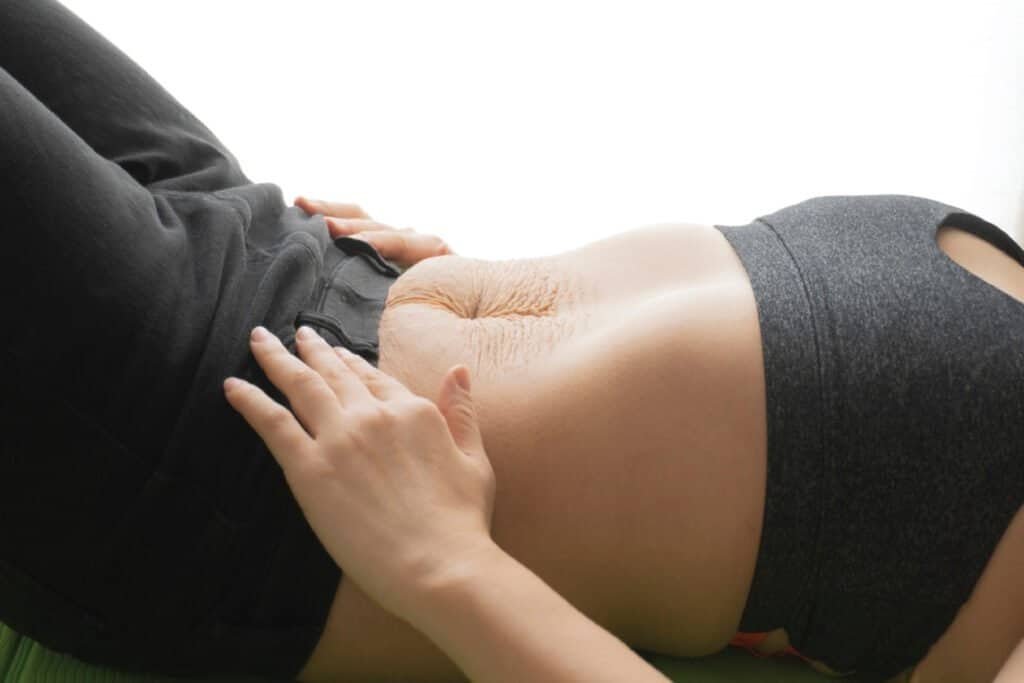
Have you noticed a gap or bulge along the middle of your tummy after pregnancy? Perhaps your abdomen forms a small “dome” when you sit up, get out of bed or exercise.
You may have heard this called abdominal separation or diastasis recti.
Diastasis recti is common, particularly during and after pregnancy. While it can sometimes look worrying, it doesn’t mean your abdominal muscles are permanently damaged.
With the right guidance and progressive strengthening, you can work towards getting your core stronger and feeling more confident with everyday activities and exercise.
Diastasis recti, also known as diastasis rectus abdominis (DRA), refers to a widening of the space between the two sides of your rectus abdominis — the muscles running down the front of your abdomen.
During pregnancy, your abdominal wall naturally stretches as your baby grows. The connective tissue between the abdominal muscles also stretches to accommodate these changes.
Some degree of separation during pregnancy is therefore very common.
After delivery, the abdominal wall gradually recovers. However, for some women, the separation and changes in abdominal function remain noticeable for longer.
Not everyone with diastasis recti experiences symptoms.
You may notice:
Some women also experience back or pelvic discomfort after pregnancy. However, having diastasis recti doesn’t automatically mean it is causing your pain.
This is why an individual assessment can be useful.
Usually, no.
Despite how it is sometimes described online, your abdominal muscles haven’t simply “split apart.”
Diastasis recti is better understood as a change in the width and function of the abdominal wall and the connective tissue running through its centre.
And here’s something important:
Rehabilitation isn’t only about closing the gap.
How well your abdominal muscles function, manage pressure and support you during everyday movement can be just as important as the distance between them.
The aim is to help you build an abdominal wall that is strong, functional and able to cope with your daily activities.
Yes. Women’s Health Physiotherapy can help assess how your abdominal muscles are functioning and guide you through appropriate rehabilitation.
Your physiotherapist may assess:
Rather than giving everyone the same set of “core exercises,” your rehabilitation should be progressed according to your body, your recovery and what you want to get back to doing.
There isn’t one magical exercise that will suddenly “close the gap.”
Rehabilitation may initially involve learning how to coordinate your breathing and abdominal muscles before gradually introducing more challenging strengthening exercises.
A simple progression might look like:
Breathing & core control → gentle strengthening → functional exercises → resistance training → return to exercise or sport
The exact progression will be different for everyone.
This is a very common concern.
You may have seen advice online telling women with diastasis recti:
“Never do sit-ups.”
“Don’t plank.”
“Don’t lift anything heavy.”
But rehabilitation isn’t usually about avoiding movements forever.
Certain exercises may need to be modified initially depending on your symptoms, control and stage of recovery.
The long-term goal is to gradually build your body’s capacity, rather than becoming afraid of movement.
Your physiotherapist can help determine where you should start and how your exercises can safely progress.
Your abdominal muscles don’t work alone.
Your diaphragm, abdominal muscles, back muscles and pelvic floor all contribute to how your body manages movement and pressure.
This becomes particularly relevant during pregnancy and after childbirth.
If you also experience:
mention these symptoms during your physiotherapy assessment.
They may be more common after pregnancy than people realise, but that doesn’t mean you simply have to put up with them.
Consider a physiotherapy assessment if you:
You don’t need to wait until something becomes painful before asking for help.
Pregnancy and childbirth place significant demands on your body.
Postnatal recovery doesn’t have to be about rushing to “get your old body back.”
Instead, think about helping your body become strong, capable and confident again.
At Ropheka Physiotherapy & Sports Injury Centre in Seremban, our Women’s Health Physiotherapy service supports women through pregnancy, postnatal recovery and selected pelvic health concerns, including diastasis recti.
Your physiotherapist can assess how your abdominal muscles are functioning, explain the findings in simple terms and guide you through an individualised rehabilitation programme based on your needs and goals.
You don’t have to rely on random exercises you find online.
A proper assessment can help you understand what is happening with your abdominal muscles and, more importantly, what you can do to become stronger.
Book a Women’s Health Physiotherapy assessment with Ropheka Physiotherapy & Sports Injury Centre in Seremban.
This article is intended for general educational purposes and does not replace an individual medical or physiotherapy assessment.