
One moment you’re running, playing badminton, football or pickleball — and the next, your knee twists, you hear or feel a “pop”, and suddenly walking doesn’t feel quite so simple anymore.
ACL and meniscus injuries are two common knee injuries we see in active individuals. But they don’t only happen to professional athletes. A sudden turn on the court, an awkward landing, a slip, or even twisting your knee while your foot stays planted can be enough to cause an injury.
And if you’ve recently had an MRI showing an ACL tear, meniscus tear, or both, you may immediately wonder:
“Do I need surgery?”
The answer is: not always.
Whether your treatment involves surgery or not, physiotherapy plays an important role in helping you regain movement, strength, confidence and function.
Let’s make ACL and meniscus injuries a little easier to understand.
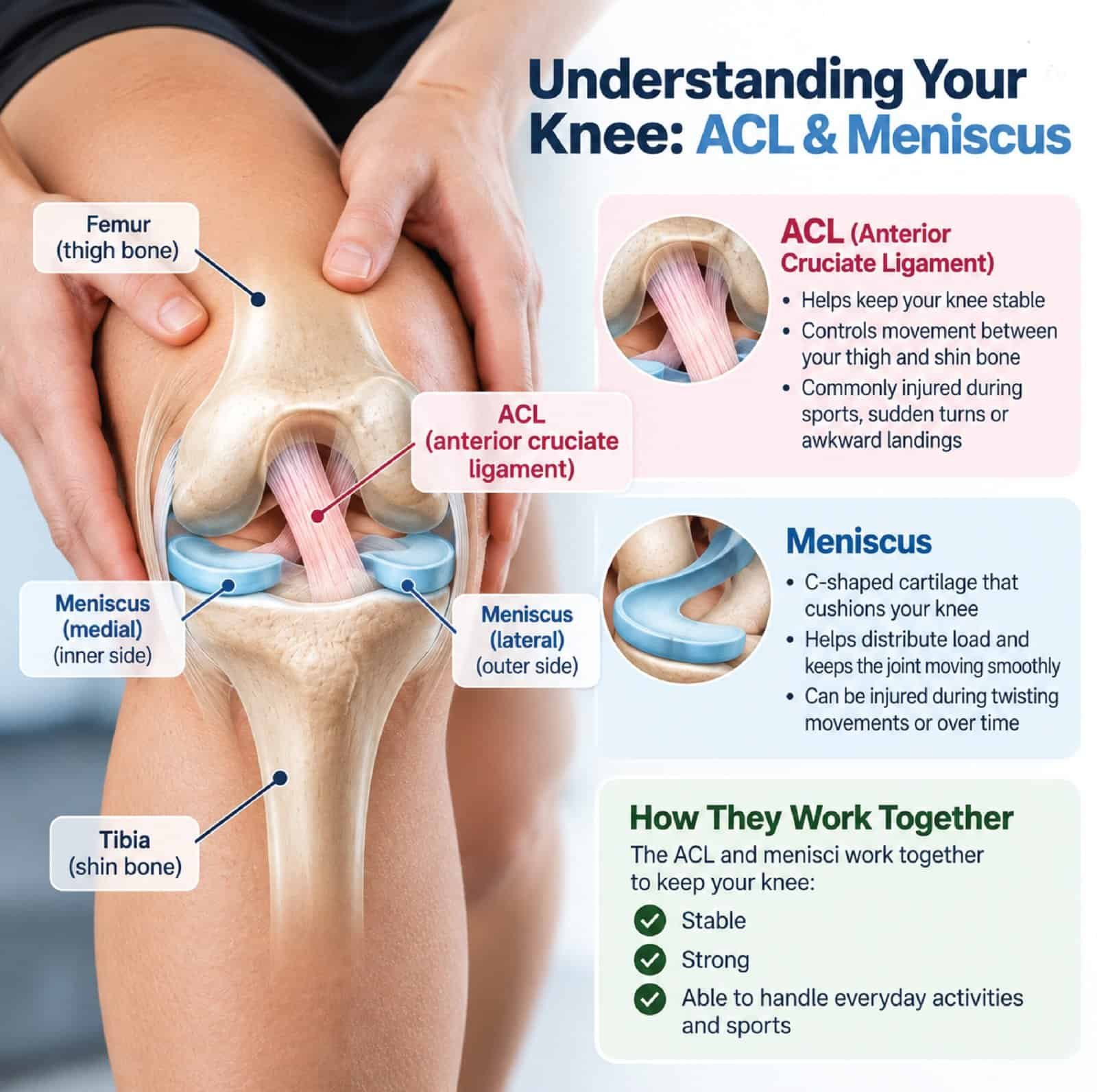
The Anterior Cruciate Ligament (ACL) is one of the major ligaments inside your knee.
Think of it as one of your knee’s important stabilisers. It helps control movement between your thigh bone (femur) and shin bone (tibia), particularly during movements involving sudden changes in direction, pivoting and landing.
ACL injuries commonly happen during activities such as:
Interestingly, an ACL injury does not always require someone to crash into you. Many ACL tears are non-contact injuries — for example, when the foot stays planted while the body suddenly turns.
Some people describe hearing or feeling a pop at the time of injury.
You may also experience:
The severity can vary from a partial injury to a complete ACL tear.
Your knee contains two menisci — a medial meniscus on the inner side of the knee and a lateral meniscus on the outer side.
They are C-shaped pieces of fibrocartilage that help distribute load through the knee, contribute to stability and help the joint move smoothly.
You can think of them as part of the knee’s load-sharing and shock-management system.
Meniscus injuries can happen suddenly during twisting or sporting activities, but they can also develop gradually as the tissue changes with age.
You may notice:
Some people can still walk with a meniscus tear, which is why the severity of an injury cannot always be judged by pain alone.
Unfortunately, yes.
When a significant twisting injury occurs, more than one structure in the knee may be affected. An ACL tear can occur together with damage to the meniscus or other knee structures.
But an MRI report is only one piece of the puzzle.
At Ropheka Physiotherapy & Sports Injury Centre, we also look at how your knee is actually functioning.
Can you straighten it properly? How swollen is it? Can you walk comfortably? How strong are your quadriceps and hamstrings? Does the knee feel unstable? What activities do you need to return to?
Most importantly:
What do you want your knee to be able to do again?
That could mean returning to football — or simply being able to climb the stairs, squat, work and exercise comfortably.
No.
This is one of the biggest misconceptions surrounding ACL injuries.
Some people may be able to manage an ACL injury successfully with structured rehabilitation without undergoing ACL reconstruction. Others may benefit from surgery, particularly depending on factors such as knee instability, associated injuries, sporting demands, occupation and personal goals.
The decision should be individualised and discussed with the appropriate healthcare professionals.
And importantly, choosing non-surgical management does not mean “doing nothing.”
Good conservative management usually involves a structured rehabilitation programme designed to restore the knee’s movement, strength, control and ability to tolerate progressively more demanding activities.
Again, not every meniscus tear requires surgery.
The treatment approach depends on factors such as the type and location of the tear, your symptoms, age, activity level and whether the knee is mechanically restricted.
Many people with meniscus-related knee pain can improve with appropriate physiotherapy and progressive strengthening.
However, certain injuries — particularly when there is significant locking or other mechanical symptoms — may require further orthopaedic assessment.
This is why proper assessment matters.
Physiotherapy is not simply a few exercises and some machines.
A proper knee rehabilitation programme should progress according to your symptoms, strength, function and goals.
At Ropheka Physio in Seremban, rehabilitation may focus on:
A swollen, painful knee often struggles to move and activate its muscles normally.
Early rehabilitation may therefore focus on controlling symptoms and gradually restoring comfortable movement.
After an ACL or meniscus injury, people commonly lose the ability to fully straighten or bend their knee.
Restoring appropriate knee movement is an important part of rehabilitation.
After a knee injury, your quadriceps can lose strength surprisingly quickly.
You might look at your thigh a few weeks later and think:
“Where did my muscle go?”
Don’t worry — rebuilding it is part of the process.
Your physiotherapist will gradually introduce exercises to strengthen your quadriceps, hamstrings, glutes, calves and other muscles that help support your knee.
Strong muscles are important, but strength alone isn’t enough.
Your knee also needs good neuromuscular control — your body’s ability to coordinate movement, balance and respond to changes in position.
Rehabilitation may therefore include balance exercises, single-leg activities and progressively more challenging movements.
This is where rehabilitation becomes more interesting.
As your knee improves, your programme may progress towards:
Walking → strengthening → single-leg control → jogging → running → jumping → changing direction → sport-specific drills.
You don’t go from basic exercises straight back onto the badminton court.
Your knee needs to earn its way back.
Physiotherapy is still a major part of the journey. In fact, rehabilitation can begin before surgery. This is sometimes called prehabilitation or “prehab.”
Before ACL reconstruction, physiotherapy may help you improve:
Going into surgery with a knee that is moving and functioning well can help prepare you for the rehabilitation that follows.
ACL reconstruction is not the finish line. It is closer to the starting line of the next stage of rehabilitation.
After surgery, physiotherapy progresses gradually. Early goals may include reducing swelling, restoring knee movement and improving muscle activation.
Over time, rehabilitation progresses towards:
For athletes, returning to sport should ideally be based on more than simply asking:
“Has it been six months yet?”
Time matters, but so do strength, movement quality, confidence, symptoms and functional testing.
Recovery is not a race.
Physiotherapy is also commonly part of recovery following meniscus surgery.
However, rehabilitation can differ depending on the procedure performed. For example, recovery after a meniscus repair may involve different early precautions compared with other procedures.
Your physiotherapist should therefore work alongside your surgeon’s recommendations and gradually progress your rehabilitation according to your healing and function.
Not necessarily.
Pain is only one measurement.
You might be able to walk without pain while still having significant differences in strength, balance, endurance or control between your injured and uninjured legs.
These differences become particularly important when returning to activities involving running, jumping, landing or sudden changes in direction.
That is why rehabilitation shouldn’t stop simply because the pain has disappeared.
The goal isn’t only to have a knee that feels better.
The goal is to build a knee — and a body — that is ready for what you want to do next.
Consider getting assessed if you have persistent knee pain or swelling after an injury, difficulty straightening or bending your knee, repeated giving-way, locking or catching, or difficulty returning to your usual activities.
A physiotherapy assessment can help identify your current limitations and determine the appropriate next steps.
If we suspect an injury that requires further medical investigation, imaging or an orthopaedic opinion, we can also advise you accordingly.
At Ropheka Physiotherapy & Sports Injury Centre, we believe knee rehabilitation should be more than simply treating pain.
Our physiotherapists assess your movement, strength and functional limitations before developing a rehabilitation programme suited to your injury, lifestyle and goals.
Whether you’re recovering from an ACL injury, meniscus injury, ACL reconstruction or knee surgery, or you’re hoping to manage your injury conservatively, physiotherapy can play an important role in helping you move forward safely and confidently.
Because the ultimate goal isn’t just to get your knee moving again.
It’s to get you back to living, working, exercising and doing the things you enjoy.
If you’ve recently injured your knee, been diagnosed with an ACL or meniscus injury, or you’re unsure why your knee still doesn’t feel right, speak to our team at Ropheka Physiotherapy & Sports Injury Centre in Seremban, Negeri Sembilan.
A detailed physiotherapy assessment can help you understand what your knee needs — and what your next step should be.
Your comeback starts with understanding your injury.